
%20(1).png?width=26&height=24&name=Screenshot_1%20(1)%20(1).png)
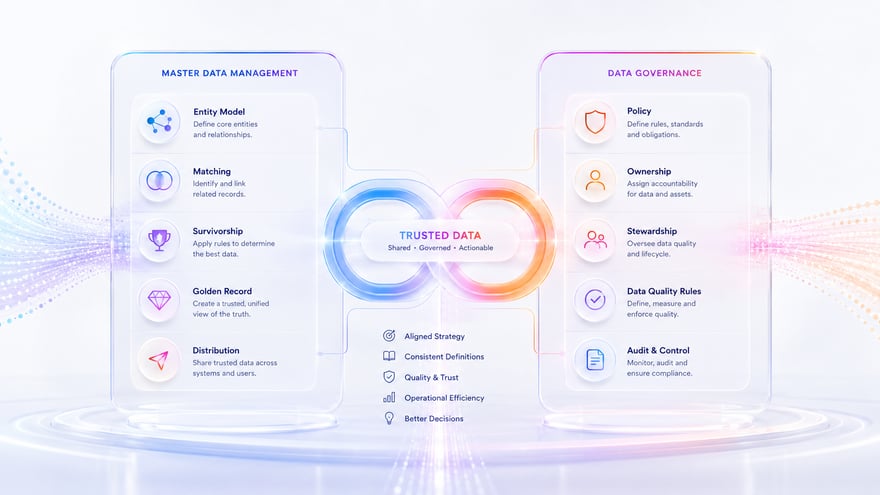
A golden record creates a trusted version of a business entity
Most enterprises do not have one complete, universally trusted 360 degree view for their customers, products, suppliers, people, assets or locations. The same entity- is often created in multiple applications like CRM, ERP, service, procurement, ecommerce and analytical systems each with different identifiers, formats, completeness and update cycles.
Master Data Management brings those fragments together for your critical data entities. It determines which source records refer to the same real-world entity, reconciles conflicting values and creates a governed record that operational, analytical and AI consumers can use with confidence. Not only that, it standardizes the values and enriches the entity using external data references.
Accurate
Values have passed defined quality, validation and matching controls.
Complete
Relevant attributes can be assembled from more than one trusted source including external subscribed sources.
Governed
Ownership, survivorship rules, lineage, workflow and stewardship make trust sustainable.
Golden Record vs Single Source of Truth vs System of Record
These terms are related but describe different architectural and operating concepts.
Where a value originates
The authoritative application for a particular process or data element. ERP may be authoritative for billing status; CRM may own communication preferences.
What the organization agrees to use
A broader enterprise concept in which people and systems rely on an agreed trusted representation for a defined purpose.
What the enterprise trusts about an entity
The consolidated, governed master-data representation created through matching, quality, survivorship and stewardship.
A system of record tells you where an attribute for the entity is maintained. A golden record tells you what the enterprise currently trusts about the attribute, about the entity.
Different systems often know different parts of the truth
Critical master data is distributed by design. Applications support different processes, so each system may be authoritative for a different part of the same entity.
CRM
Contact details, preferences and commercial relationships.
ERP
Billing, legal identity, credit and financial status.
Service
Installed base, service relationship and support history.
External
Validated identifiers, addresses and enrichment.
Trusted Golden Record
One governed identity with attribute-level lineage back to the contributing sources.
The goal is therefore not to copy every value into one place. It is to create an auto refreshed, governed enterprise identity layer that knows which records belong together, which values are trusted and why.
How a golden record is actually created
The process starts before matching. Enterprises first need an agreed semantic entity model, data standards, ownership and quality expectations. MDM then uses those foundations to resolve identity and select trusted values.
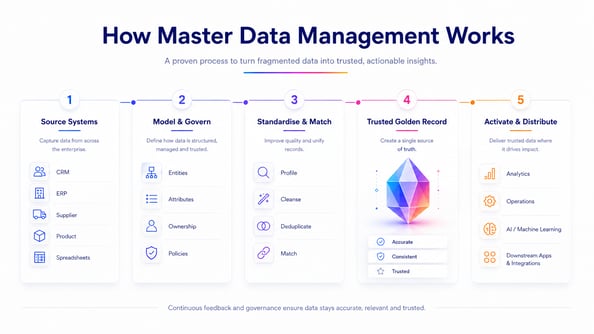
Standardise & Enrich
Normalise names, formats, addresses, codes and attribute structures. Enrich the details sourced from standardized third party data sources.
Match & Deduplicate
Identify records that represent the same entity and build duplicate clusters.
Survive & Govern
Select trusted values, handle exceptions and publish the authoritative representation.
Matching decides which records represent the same real-world entity
Before records can be consolidated, MDM must decide whether apparently different records are actually the same customer, supplier, product, person, asset or location.
Deterministic matching
Uses exact or strongly governed identifiers such as customer number, tax identifier, registration number or another trusted key.
Fuzzy matching
Compares combinations of names, addresses, emails, telephone numbers and other attributes when no single reliable identifier exists.
High-confidence matches can often be automated. Lower-confidence cases should be routed to a data steward rather than forcing a decision the organisation cannot defend.
Survivorship decides what wins when systems disagree
Matching determines which records belong together. Survivorship determines which attribute values become part of the golden record.
The strongest implementations define survivorship at attribute or attribute-group level because different applications are authoritative for different parts of the entity.
Golden records are not static
A golden record evolves as source systems change, new records arrive, relationships are updated and governance decisions are made. MDM must continually re-evaluate trust.
This is why lineage and auditability matter. Users should be able to understand not only the trusted value, but where it came from and why it won.
Golden records exist across many master-data domains
Golden Customer Record
Trusted customer or account identity across CRM, ERP, service and digital channels.
Golden Product Record
Trusted attributes, classifications, hierarchies and product relationships.
Golden Supplier Record
Trusted legal entity, vendor relationships, classifications and risk attributes.
Golden Person Record
Trusted employee, person or organisational identity across enterprise systems.
Golden Asset Record
Authoritative identity and hierarchy for equipment, facilities and enterprise assets.
Golden Location Record
Trusted site, geography, country, region and reference hierarchies.
Where does the golden record live?
There is no single architecture for MDM. The location and operational role of the golden record depend on how the MDM capability interacts with source and consuming systems.
Registry
MDM maintains identity links while most attributes remain in source systems.
Consolidation
MDM creates a trusted consolidated record for analytics and enterprise consumption.
Centralised
The MDM Platform becomes the primary place of the trusted master data creation and distribution.
Coexistence
The MDM Platform consolidates and participates directly in operational creation and synchronisation of trusted master data in both directions.
The right style depends on ownership, source-system behaviour, latency, process control and the organisation’s appetite for centralisation.
Why golden records matter for AI
AI can process vast amounts of information, but it cannot eliminate ambiguity in the underlying enterprise identities. If customers are duplicated, product definitions conflict or supplier relationships are incomplete, AI inherits that uncertainty.
Ambiguous enterprise context
Duplicate identities, inconsistent attributes and missing relationships reduce confidence in analytics and AI.
Reliable business context
Governed identities, relationships, lineage and attributes give analytics and AI a stronger foundation.
Golden record FAQs
Is a golden record the same as a single source of truth?
No. A single source of truth is a broader enterprise concept. A golden record is the consolidated, governed representation of a specific master-data entity.
Does every value in a golden record come from the same system?
No. Different systems can be authoritative for different attributes. Survivorship rules determine which source wins for each attribute or attribute group.
Is the golden record always stored centrally?
No. Registry, consolidation, coexistence and centralised MDM styles handle trusted records differently.
What happens when source data changes?
MDM re-evaluates the entity using matching, quality, survivorship and governance rules while retaining lineage and audit history.
Can AI create a golden record automatically?
AI can assist with profiling, matching, enrichment and stewardship, but ownership, authority, acceptable risk and survivorship remain governed enterprise decisions.
Ready to create trusted golden records across your enterprise?
Blue Altair helps organisations design, govern and operationalise golden records across customer, product, supplier and other critical master-data domains.
Related MDM insights
What Is Master Data Management?
The complete enterprise guide to trusted master data, governance, golden records and AI readiness.
How to Implement MDM
A practical enterprise roadmap from domain selection through implementation and sustained value.
Explore MDM Services
Strategy, architecture, data quality, golden records, governance, integration and managed services.