
%20(1).png?width=26&height=24&name=Screenshot_1%20(1)%20(1).png)
Key takeaways
What is master data?
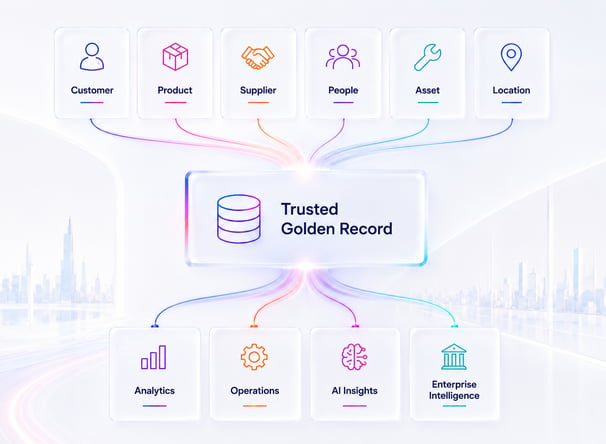
Master data describes the relatively stable, high-value business entities that are reused across processes and systems. Transactional data tells you what happened. Master data tells you who or what the transaction is about.
Customer
Person, household, organisation or account across CRM, ERP, billing and service.
Product
Product, SKU, material, part or offering across ERP, PIM, ecommerce and PLM.
Supplier
Vendor, supplier organisation and contact across ERP, procurement and risk.
Location
Site, branch, store, plant and geography across logistics, facilities and ERP.
Asset
Equipment, machine, vehicle and installed base across EAM, service, IoT and ERP.
People
Employee, contractor and salesperson across HCM, CRM and identity systems.
Reference data
Country, currency, category and code sets that standardise shared business meaning.
Hierarchies
Organisational, customer, product and geography relationships used across the enterprise.
Reference data is often managed alongside MDM because it standardises the codes and classifications that master data depends on. The exact boundary varies by organisation, but the governing principle is the same: shared business meaning must be consistent wherever it is used.
Why enterprises need Master Data Management
A CRM may call a customer Acme GmbH, finance may hold ACME Germany GmbH, and a service platform may identify the same organisation under a legacy account code. Each record can be locally valid while the enterprise view remains inconsistent.
Siloed data sources
Critical master data is scattered across disconnected applications, functions and spreadsheets.
Duplicate records
Multiple versions of the same entity coexist, making it difficult to know which one is authoritative.
Poor data quality
Attributes are incomplete, outdated, formatted differently or governed by conflicting rules.
Conflicting reporting
Systems identify and group entities differently, so teams debate the numbers before acting.
Unclear ownership
No explicit owner or steward is accountable for resolving material master-data issues.
Weak AI readiness
AI inherits inconsistent identities, relationships and attributes from the enterprise data beneath it.
MDM addresses the shared identity and control problem behind these symptoms. It does not eliminate every data issue, but it creates a governed foundation for the business entities that processes, analytics products and AI depend on.
How does MDM work?
Most MDM solutions perform a similar sequence of activities even though product terminology differs.
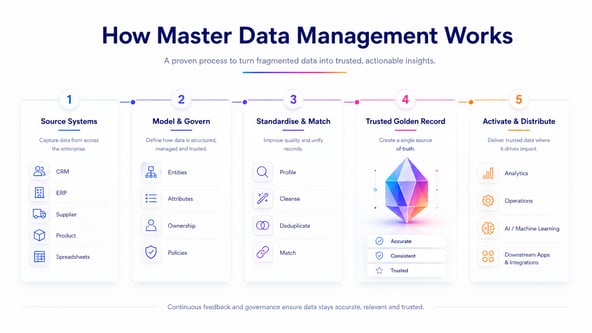
Connect and profile source data
Identify systems that create or consume the domain. Profile representative data to understand duplication, completeness, formats and source authority.
Standardise and validate
Cleanse and standardise values so records can be compared consistently; apply validation rules, reference data and business logic.
Match and deduplicate
Use exact and probabilistic rules to identify records that likely represent the same real-world entity.
Apply survivorship
Determine which values populate the authoritative record by source preference, recency, verification or steward decision.
Govern exceptions and change
Route ambiguous matches, policy exceptions and material changes through stewardship, approval and audit controls.
Publish trusted master data
Distribute mastered records to applications, data platforms, analytics products and AI consumers using suitable integration patterns.
Monitor and improve
Track quality, exceptions, match accuracy, stewardship performance, source onboarding and business value, then refine continuously.
What is a golden record in MDM?
A golden record is the authoritative representation of a business entity after relevant source records have been standardised, matched and governed. It is sometimes described as a single source of truth, but that phrase can be misleading if it implies every other system disappears.
In many enterprise architectures, source systems continue to perform their operational roles. MDM establishes a trusted master representation and the rules for how that representation is created, changed and distributed. Good implementations retain lineage back to contributing source records so users can understand where important values came from.
Legal name
Preferred from ERP when ERP is the verified legal source.
Contact details
Preferred from CRM when verified and more recent.
Address
Selected from the most recent validated source or enrichment service.
Risk classification
Authoritative from the compliance system.
Customer segment
Governed by the business steward or approved classification logic.
Lineage
Preserves traceability back to contributing source records and decisions.
Core capabilities of an enterprise MDM platform
A mature MDM capability combines technology, governance and operating practices rather than relying on one feature.
Data modelling
Entities, attributes, relationships, hierarchies and reference structures.
Data quality
Profiling, validation, standardisation, cleansing and enrichment.
Matching & entity resolution
Identifies records that represent the same real-world entity.
Survivorship
Selects the values that form the authoritative mastered record.
Workflow & stewardship
Routes exceptions, approvals and data-change requests to accountable people.
Governance & security
Ownership, policies, decision rights, access control and auditability.
Integration & distribution
Onboards sources and publishes trusted data to consuming systems.
History & lineage
Shows record change and the sources contributing to mastered values.
Monitoring & metrics
Measures quality, exceptions, adoption, operational performance and value.
MDM vs data governance vs data quality
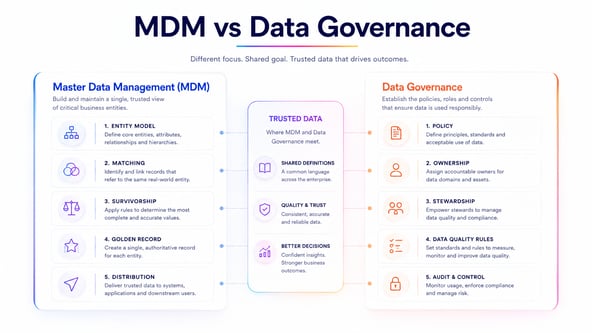
Master Data Management creates and operates trusted master records for critical shared entities. Data governance defines policies, ownership, standards and decision rights. Data quality measures and improves whether data is fit for purpose. Data integration moves and synchronises data. Metadata management helps people understand what data exists, what it means and where it came from.
The four common MDM implementation styles
There is no single architecture that is right for every organisation. These styles are design choices, not maturity badges.
Registry
The hub maintains identifying information and links across source records, often leaving operational systems authoritative.
Consolidation
Data is cleansed, matched and consolidated in the hub for analytics, compliance or enterprise reporting.
Coexistence
The hub and selected source systems share responsibility, with trusted changes flowing in both directions.
Centralised
The MDM platform becomes the primary place where master data is created and governed before downstream consumption.
A large enterprise may use different styles for different domains or evolve them over time as governance, architecture and business needs change.
What business value does MDM create?
The business case should be linked to measurable operational outcomes rather than the abstract idea of having cleaner data.
Faster processes
Less manual reconciliation across onboarding, orders, procurement, service and reporting.
Better experiences
Fewer duplicate profiles, inconsistent communications and hand-off errors.
Reliable analytics
Common identities and hierarchies reduce disagreement between reports and data products.
Lower operational risk
Controlled creation and change reduce invalid, incomplete or unauthorised master data.
Simpler transformation
Mergers, ERP modernisation and cloud migration become easier when core entities are understood.
Stronger AI readiness
Models and agents receive more consistent identities, relationships and business context.
Why MDM matters for AI-ready data
AI does not remove the need for trusted master data. It increases it.
An AI system can summarise, predict or automate based on the data it receives, but it still needs a dependable understanding of the entities involved. If the enterprise has five inconsistent versions of the same supplier, product or customer, an AI application can inherit that ambiguity.
- Consistent enterprise identities
- Governed attributes and relationships
- Trusted hierarchies and classifications
- Lineage back to contributing sources
- Clearer ownership and business context
- Better matching and anomaly recommendations
AI can assist with matching, anomaly detection, data-quality recommendations and steward productivity, but accountable governance remains essential for material decisions.
How do you know if you need MDM?
MDM is not a substitute for every data discipline. If the problem is confined to one application or can be solved with a targeted quality rule, an enterprise MDM programme may be unnecessary. The key question is whether multiple processes and systems need a shared, governed understanding of the same business entities.
How should an enterprise start an MDM programme?
A common mistake is trying to master everything at once. A more pragmatic approach is to choose a high-value domain, prove the operating model with representative data, then scale using reusable patterns.
Blue Altair's 6D Transformation Framework connects six continuous dimensions Strategy & Governance, Information & Models, Platforms & Integration, Transformation Delivery, People & Adoption, and Intelligence & Value and moves the capability through six maturity states: Siloed, Visible, Governed, Connected, Intelligent and Adaptive.
Discover
Assess maturity, priorities and data challenges; select the highest-value starting domain.
Demonstrate
Use representative data to validate the model, governance approach and business value.
Develop
Build governed models, matching, quality, stewardship and reusable foundations.
Distribute
Connect source and consuming systems and distribute golden records across the ecosystem.
Deploy
Move into production, activate governance and prepare users and operational teams.
Drive
Improve continuously, expand domains and sustain measurable value.
A practical MDM readiness checklist
If several of those answers are unclear, start with discovery rather than software selection.
Master Data Management FAQ
What does MDM stand for?
What is an example of Master Data Management?
Is MDM the same as a single source of truth?
What is the difference between MDM and data governance?
Does MDM improve data quality?
Is MDM required for AI?
Which MDM domain should we start with?
From understanding MDM to building the capability
Master Data Management becomes valuable when it changes how the enterprise operates not when it merely creates another repository. Start with a focused discovery exercise to assess maturity, identify the right first domain and turn the problem into a practical roadmap and business case.
Related MDM insights
Why Data Governance Makes Good Business Sense
How strong governance can improve data quality, operational efficiency and business value.
Master Data Management and Data Governance
Explore Blue Altair's wider approach to trusted enterprise data.
Assessment & Strategy
Identify the right technical starting point and roadmap for your MDM transformation.