
%20(1).png?width=26&height=24&name=Screenshot_1%20(1)%20(1).png)
April 22, 2026
Introduction
Recently, the engineering community has been talking a lot about the risks of AI agents interacting with legacy systems. Imagine the nightmare of an AI agent, assigned to handle routine database maintenance, ignoring a code freeze and unintentionally deleting crucial production records.
Whether it’s a malicious breach or just a misunderstanding of context, it highlights a visceral warning: we cannot govern non-deterministic actors with rigid, deterministic infrastructure. Right now, we are facing an integration crisis. A massive percentage of enterprise AI pilots fail to reach production. Why? Because our legacy "if/then" pipelines simply cannot navigate the fluid, reasoning-driven reality of the modern world.
Evolution
For the last decade, API Management and iPaaS platforms have been the backbone of digital transformation. We relied on them to automate workflows, connect siloed systems, and keep data moving safely.
But as we embed AI into our core operations, the rigid nature of traditional iPaaS is becoming a bottleneck. Enter Probabilistic iPaaS - the next generation of integration platforms designed to handle uncertainty, reason about outcomes, and adapt autonomously.
Why Traditional iPaaS Is Reaching Its Limits
If you've spent any time building integrations, you know traditional platforms rely on strict assumptions:
-
- Deterministic execution: Workflows run exactly as coded, step-by-step.
- Static error handling: If X fails, retry Y times, then send an alert.
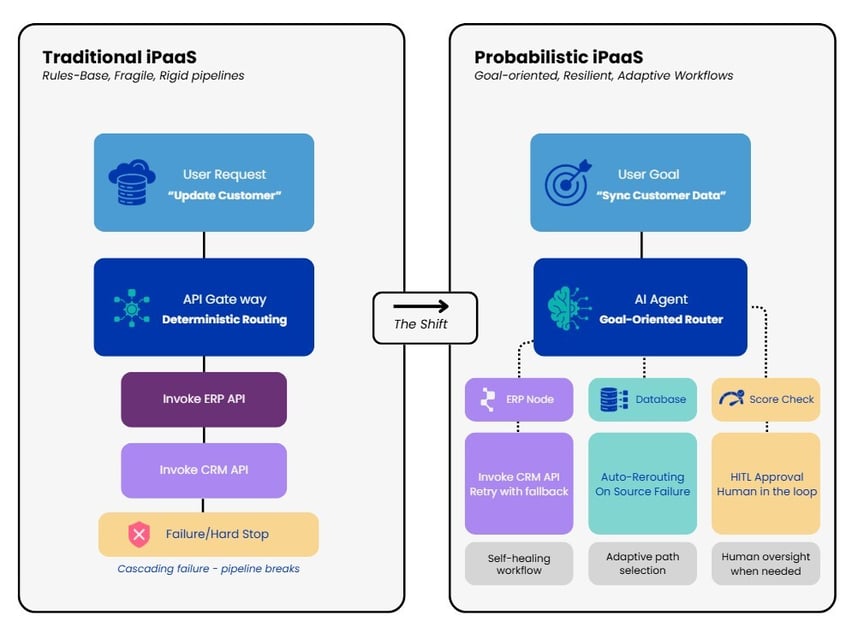
This is perfect for predictable systems. But AI agents are probabilistic - their outputs, timing, and confidence levels vary. They don’t guarantee exact, repeatable responses. The harsh truth is that the old iPaaS model was never designed for actors that "think. When you force a probabilistic AI into a deterministic pipeline, things break:
-
- Retries cascade into massive system failures.
- Data schemas drift, causing mismatched records.
- Debugging becomes a needle-in-a-haystack nightmare.
What Probabilistic iPaaS Brings to the Table
Probabilistic iPaaS platforms address this challenge by introducing self-healing, goal-oriented, and confidence-aware pipelines.
1. Self-Healing Workflows
Instead of failing when a step encounters an error:
-
-
The system evaluates alternative execution paths
-
Attempts auto-correction, rerouting, or fallback strategies
-
Learns from past failures to improve future resilience
-
Example: An AI agent fails to enrich a customer record due to incomplete data. The pipeline automatically tries an alternative source, flags confidence levels, and continues without human intervention.
2. Goal-Oriented Orchestration
Traditional pipelines care about the steps executed. Probabilistic pipelines care about outcomes achieved.
-
-
Define intent or business goal for the workflow
-
The system dynamically chooses the optimal path to achieve that goal
- Step order, data sources, and integrations are chosen contextually
-
Example: Instead of rigidly calling CRM → ERP → Analytics, the pipeline determines the fastest route that guarantees up-to-date insights for a customer engagement dashboard.
3. Confidence-Aware Execution
Each AI-driven action is accompanied by a confidence score:
-
-
Pipelines can branch differently based on confidence thresholds
-
Decisions below a certain threshold can trigger validation steps or human-in-the-loop review
- Ensures reliability without sacrificing agility
-
Example: If an AI translation service returns a low-confidence output, the pipeline can automatically call a second service or route it for human validation.
4. Drift Detection & Adaptive Mapping
Traditional iPaaS struggles with changing schemas, evolving APIs, or shifting business rules. Probabilistic pipelines:
-
-
Detect schema and data drift automatically
-
Adjust mappings dynamically using AI reasoning
-
Maintain data integrity without manual intervention
-
Example: When a partner API changes the field name for “customer_id,” the probabilistic pipeline detects the change, adapts the mapping, and continues execution.
How Blue Altair is Building the Future
Transitioning from rigid pipelines to probabilistic integrations doesn't have to disrupt your core operations. At Blue Altair we bridge the gap between traditional iPaaS landscapes - whether your foundation is built on Apigee, SnapLogic, Workato, Mulesoft, Boomi or others - and the agentic future.
We help enterprise engineering teams:
-
Assess & Modernize: Identify the safest, highest-value areas to introduce goal-oriented, self-healing flows into your current architecture.
-
Deploy Agentic Pipelines: Build integrations that natively handle non-deterministic AI outputs and auto-correct failures.
-
Enforce Practical Governance: Implement blast-radius containment, semantic rate limiting, and secure human-in-the-loop (HITL) triggers.
Conclusion
The iPaaS landscape is fundamentally shifting. As AI transitions from a novelty to the core of enterprise operations, rigid "if/then" workflows will no longer cut it. Probabilistic, self-healing pipelines are the future—systems that don't just move data, but reason, adapt, and deliver outcomes.
For integration architects and tech leaders, the question is no longer if you will adopt probabilistic iPaaS. The question is: how quickly can you evolve your architecture to handle the agents of tomorrow?